
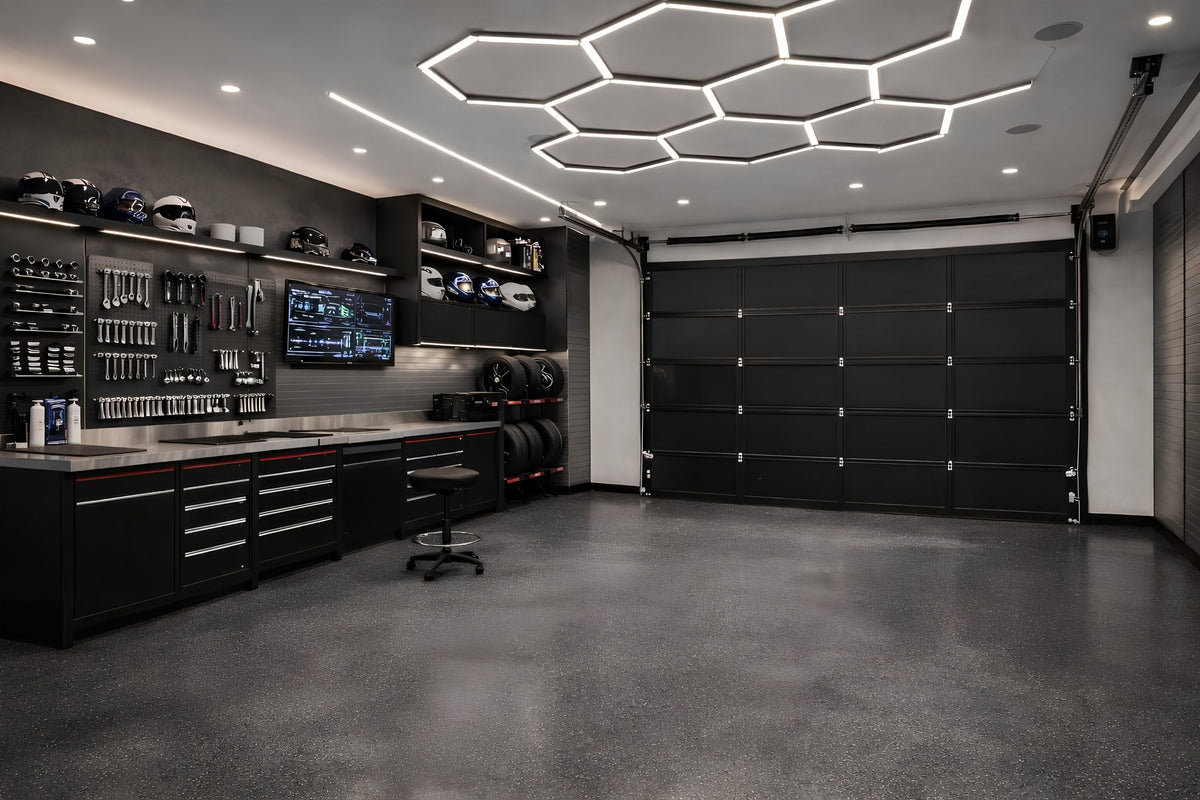
If your garage is dark and you want it fixed tonight for under $40, buy a deformable LED. If you want the garage people take pictures of, buy a hex grid. That's the honest answer. Below is the side-by-side, so you can decide which problem you're actually solving.
What is a deformable LED garage light?
A deformable light is a high-output LED with fold-out panels that screws into a standard light socket. You aim the panels where you want light, and you're done. No mounting, no wiring, no ladder dance beyond swapping a bulb.
Our Deformable LED Garage Light is $34.99, listed at 80W and 7,000 lumens at 6500K, with three adjustable panels and an E26/E27 base. That's a lot of light for the money.
What is a hex grid garage light?
A hex grid is a set of LED tubes that snap together into a honeycomb on your ceiling. It spreads light across a wide area, cuts shadows and gives the garage a finished, custom-shop look. It needs mounting clips, some layout planning and an outlet (or an electrician if you want it hardwired).
The Hex Grid Garage Light, 6500K comes in 5, 8 and 14 hex layouts from $176.99. The 5-Grid Honeycomb Kit is $139.99 and listed at 26,400 lumens.
Deformable LED vs hex grid: side-by-side
| Deformable LED | Hex grid | |
|---|---|---|
| Cost | $34.99 each | $139.99 for a 5-grid kit; from $176.99 for 5/8/14 hex layouts; more for framed or RGB |
| Install | Screw into an existing socket. Minutes. | Plan layout, mount clips, connect tubes, run power. An afternoon for two people. |
| Brightness | Listed 7,000 lm per light, concentrated around the socket | Listed 26,400 lm for the 5-grid kit, spread across the ceiling |
| Light quality | Bright center, more shadows at the edges | Even, wide coverage with fewer shadows |
| Look | Utility. Does the job, not a showpiece. | The "finished garage" look. Showroom and detailing vibe. |
| Best for | Renters, tight budgets, quick upgrades, storage and parking | Workshops, detailing, garages you want to show off |
Where the deformable LED wins
- Value. $34.99 for a listed 7,000 lumens is hard to beat. Two of them in a one-car garage is a massive jump from a bare bulb.
- Speed. No tools beyond a ladder. Swap the bulb and flip the switch.
- Renter friendly. No holes in the ceiling. Take it with you when you move.
- Adjustable. Point the panels toward the bench or the car instead of straight down.
Watch-outs: it's a big, heavy "bulb," so make sure your socket and fixture can physically fit and support it, and don't put it inside an enclosed fixture where heat builds up. Check the listing's guidance on garage door opener sockets before using one there; some LED bulbs can also interfere with opener remotes.
Where the hex grid wins
- Even light. Light comes from many points across the ceiling, so you get fewer shadows around the car and under the hood.
- Coverage. A 14 hex layout can cover most of a two-car ceiling. A couple of sockets can't.
- Detailing. The long, even reflections are why detailers use them to spot swirls and high spots.
- The look. It's the centerpiece of a finished garage. Nothing else changes the room's vibe as fast.
- One power point. A whole grid typically runs off a single plug, so you are not limited by where the old sockets happen to be.
Watch-outs: higher cost, a real install, and you need to plan around the garage door track and opener. Hardwiring should go to a licensed electrician.
Cost math: lumens per dollar
Here's where it gets interesting. Based on listed specs, the two are closer on raw value than you'd think:
- Deformable LED: 7,000 lm for $34.99, roughly 200 lumens per dollar.
- 5-Grid Hex Kit: 26,400 lm for $139.99, roughly 190 lumens per dollar.
Four deformables cost about the same as the 5-grid kit and add up to a similar listed output. The difference is everything else. Four deformables need four well-placed sockets that can handle them. The grid needs one outlet and spreads the light evenly across the ceiling. So the deformable wins when you already have the sockets. The grid wins when you don't, or when even light and the look matter.
Which should you buy?
Buy the deformable LED if...
- You need more light now and the budget is tight.
- You rent, or you're not ready to commit to a layout.
- The garage is mostly for parking and storage.
- You already have ceiling sockets in the right spots.
Buy the hex grid if...
- You work in the garage: wrenching, woodworking, detailing.
- Shadows and dark corners bug you.
- You're building a showpiece garage and want the look.
- You're already putting money into floors, storage or a coating.
Or do both
Plenty of garages use a hex grid over the main bay and deformables in the existing sockets over storage or the side bay. It's a smart way to phase the budget: deformables now, grid later. Plan the phases in the Garage Builder so the grid lands where you'll actually want it.
A quick word on brightness numbers
Listed lumens are a fixture's output, not what reaches your bench. A single bright point source loses more to distance and shadow than a wide grid does. So don't just add up lumens and call it even. Rule of thumb: about 30-50 lumens per square foot for parking, 75-100 for a workshop and 100-150 or more for detailing.
FAQ
Is a deformable LED as bright as a hex grid?
Not overall. One deformable is listed at 7,000 lumens; the 5-grid hex kit is listed at 26,400 and spreads it more evenly across the ceiling.
How many deformable lights do I need?
One or two usually covers a one-car garage for parking. A two-car workshop typically needs several, or a grid.
Can I upgrade from deformables to a hex grid later?
Yes. Many owners start with deformables and add a grid once the rest of the garage comes together.
Which is better for detailing?
The hex grid. Even, wide light and long reflections make paint defects easier to spot.
Whichever way you go, the full garage lighting collection ships free in the US. Subscribers get 10% off their first order.
Plan it first
See this project in your garage.
Try lights, racks, walls and floor finishes in the Garage Builder, then add the whole build to your cart.
Open Garage Builder