Man cave guide
Cornhole Board Distance and Garage Setup: Regulation Sizes That Fit

In this guide
Regulation cornhole puts the front edges of the two boards 27 feet apart. Each board is 24 by 48 inches, so the back edges end up about 35 feet apart, and you need a lane roughly 8 feet wide for the boards and the pitcher's boxes beside them. Most garages are only 20 to 24 feet deep, so a full regulation court rarely fits inside one lengthwise. Your options are a shortened indoor distance, the width of a three-car garage, or one board inside with the door open and the other on the driveway. Here are the regulation sizes, what fits in each garage, and how to set it up so the boards stay put.
Regulation cornhole dimensions
| Item | Regulation size | Notes |
|---|---|---|
| Board playing surface | 24 x 48 in | Smooth top so bags slide but don't fly off |
| Hole | 6 in diameter | Centered 9 in from the top edge and 12 in from each side |
| Board height | About 12 in at the back edge | Front edge roughly 2.5 to 4 in off the ground, depending on the rule set |
| Distance between boards | 27 ft, front edge to front edge | About 35 ft from back edge to back edge |
| Casual or junior distance | About 21 ft, front edge to front edge | A common shorter distance for kids and backyard games |
| Pitcher's box | About 3 ft wide x 4 ft long | One on each side of each board; players throw from inside it |
| Foul line | The front edge of the board | Your foot can't cross it when you throw |
| Full court | About 8 ft wide x 40 ft long | Board plus a pitcher's box each side, with a little room behind each board |
| Bags | About 6 x 6 in | Roughly 15.5 to 16 oz under American Cornhole League rules |
These are the widely published league dimensions. If you're setting up for league or tournament play, check the current rulebook for your organization, since details like front-edge height and bag fill vary slightly.
What fits in your garage
Players stand beside the boards, not behind them, so the length you need is the distance between the boards plus the boards themselves, about 8 to 9 feet total for the two board footprints. Measure your clear space wall to wall and subtract 9 feet to see the front-to-front distance you can play.
| Space | Typical size | Cornhole setup that fits |
|---|---|---|
| One-car garage | About 12 x 20 to 14 x 24 ft | A short practice lane of about 11 to 15 ft front to front, or one board inside and throw from the driveway |
| Two-car garage | About 20 x 20 to 24 x 24 ft | About 11 to 15 ft lengthwise. Corner to corner gives roughly 18 to 24 ft, but the corners leave little room to stand beside the boards |
| Three-car garage, cars out | About 30 to 36 ft wide x 20 to 24 ft deep | Across the width, about 21 to 27 ft front to front. Full regulation needs roughly 36 ft of clear width |
| Garage plus driveway | Door open | Full regulation: one board just inside the door, the other 27 ft out on the driveway |
| Long basement, barn or pole building | 40 ft or more of clear length | Full regulation indoors, if the ceiling is high enough for a real arc |
Garage sizes are typical ranges, not standards. Measure yours, including anything that sticks out from the walls like shelving, a water heater or a workbench.
How to set up the boards
- Pick the lane. Clear a strip about 8 to 10 feet wide with nothing breakable behind either board. A TV or a car's paint behind a board will eventually take a hit.
- Place the first board. Set it at one end of the lane with the hole at the far end, away from the throwers.
- Measure the distance. Run a tape from the center of the first board's front edge 27 feet (or your chosen distance) and set the second board's front edge there, facing the first.
- Square them up. Measure diagonally from the left front corner of one board to the right front corner of the other, then the opposite diagonal. When both match, the boards are lined up.
- Level them. Most garage slabs slope toward the door for drainage. Shim the low board so both sit the same way, or bags will drift.
- Mark the boxes. Use floor tape to mark the foul line at each board's front edge and a 3 by 4 foot pitcher's box on each side.
- Check overhead. Toss a few bags and watch for the opener rail, door track, hanging lights and rafters.
Ceiling height and lighting
Bags travel in an arc, and a typical 8 to 10 foot garage ceiling flattens it. Tournament venues have far higher ceilings than any home garage, so expect a lower, flatter throw indoors and consider a shorter distance, which needs less arc. Run the lane beside the opener rail rather than directly under it where you can, and keep hanging shop lights out of the flight path.
Light the boards evenly so throwers can see the hole from 27 feet without lights shining in their eyes. Fixtures mounted tight to the ceiling are less likely to get clipped than hanging ones. A 5-grid hexagon LED kit spreads bright, even light across a bay, and our man cave lighting range adds warmer accent light for the hangout side.
Flooring and keeping the boards in place
- Stop the slide. Boards can creep on smooth concrete or tiles after a few hard throws. Rubber feet or a rubber mat under each board hold them in place.
- Clean the lane. Bags pick up dust and oil from a garage floor and carry it onto the boards. Sweep before you play, and keep the lane away from the parking spot.
- Tile the zone. Interlocking garage floor tiles make the lane cleaner and more comfortable to stand on for a long session. A graphite gray tile pack under the lane, with a contrasting color in the lounge, marks the game zone.
- Mind the driveway slope. If one board is outside, shim it level and keep the door track clear of the throwing line.
Make it part of the man cave
- Store the boards on the wall. Two boards stand about 2 by 4 feet each. Wall hooks or a bracket keep them off the floor between games.
- Give spectators a spot out of the lane. A high-top table or swivel bar stools along the side wall let people watch without standing in the throw line. More options are in home bar furniture.
- Add a scoreboard. A chalkboard or a wall-mounted flip scoreboard by the boards keeps the count honest. Scoring is simple: 3 points for a bag in the hole, 1 for a bag on the board, and points cancel between teams each round.
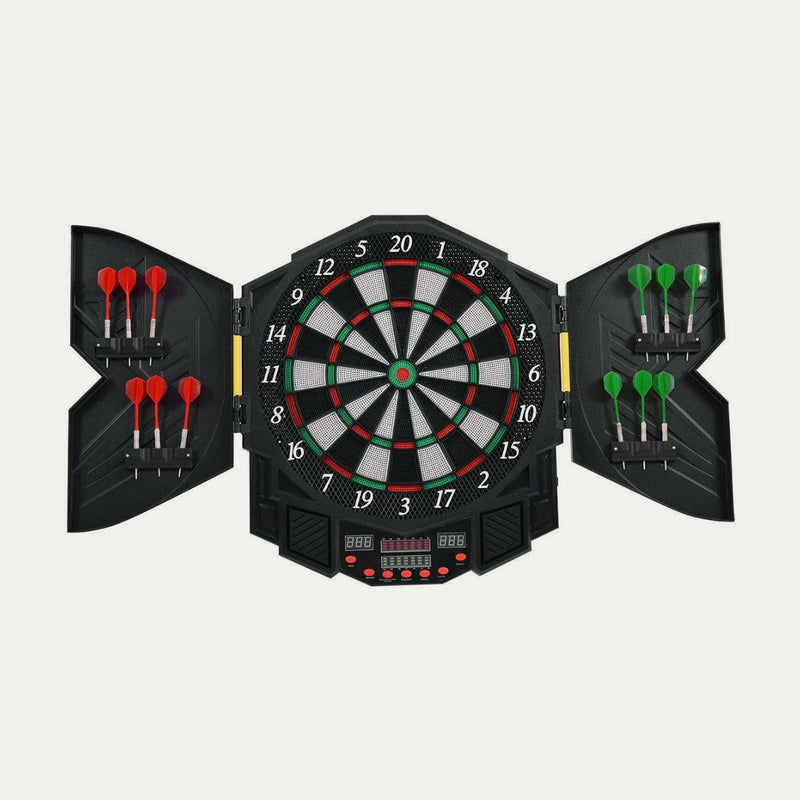
- Add another game. Cornhole pairs well with a dartboard or a card table from our game room collection. Our game room ideas guide lists the space each game needs.
Plan the lane
Lay out the lane, the parking bay and the lounge at real dimensions in the Man Cave Builder to see what fits. For the rest of the room, see our garage man cave ideas and the full man cave ideas guide.
Cornhole FAQ
How far apart are cornhole boards?
Regulation distance is 27 feet from the front edge of one board to the front edge of the other, which puts the back edges about 35 feet apart. Many casual and junior games shorten it to about 21 feet front to front. Indoors, any distance that suits your space works for practice and fun.
Can you play cornhole in a garage?
Yes, at a shorter distance in most garages. A typical two-car garage is 20 to 24 feet deep, which leaves about 11 to 15 feet between the boards lengthwise. For full regulation, open the door and put one board on the driveway, or use the width of a three-car garage with the cars out.
How much space do you need for a cornhole court?
Plan about 8 feet wide and 40 feet long for a regulation court: the 27 foot gap, two 4 foot boards and a little room behind each one. Pitcher's boxes about 3 feet wide sit on both sides of each board, and a few extra feet of width keeps spectators out of the way.
What are regulation cornhole board dimensions?
A regulation board has a 24 by 48 inch playing surface with a 6 inch hole centered 9 inches from the top and 12 inches from each side. The back edge sits about 12 inches off the ground and the front edge roughly 2.5 to 4 inches, depending on the rule set.
Plan it first
Build this man cave before you buy it.
Pick your space, size, vibe and budget, and the Man Cave Builder turns it into a real kit you can add to cart in one click.
Open the Man Cave BuilderShop this guide
Game Room


Gaming & Seating
Folding Floor Gaming Chair, 14 Adjustable Positions — Gray


Gaming & Seating
Swivel Floor Gaming Chair, 6-Position Backrest — Red & Black


Keep reading