Man cave guide
Home Theater Man Cave Setup: Screen Size, Seating Distance and Sound
In this guide
The fastest way to get a home theater man cave right is to choose the screen size from the seating distance, not the other way around. Sit about 1.2 to 1.6 times the screen's diagonal away, which gives a viewing angle between roughly 40 degrees (THX's recommendation for an immersive picture) and 30 degrees (SMPTE's long-standing minimum). Mount a TV so the center of the screen is close to seated eye height, about 42 inches off the floor for a typical sofa, put the front speakers at ear level, and control the light before you spend money on gear. Below are the charts, the speaker layout and what changes when the theater is in a garage.
Screen size and seating distance
Viewing angle is how much of your field of view the screen fills. For a 16:9 screen, the closest comfortable seat is about 1.2 times the diagonal (40 degrees) and the farthest is about 1.6 times the diagonal (30 degrees).
| Screen size (16:9) | Screen width | Closest seat (about 40°) | Middle (about 36°) | Farthest seat (about 30°) |
|---|---|---|---|---|
| 55 in | 48 in | 5.5 ft | 6 ft | 7.5 ft |
| 65 in | 57 in | 6.5 ft | 7.3 ft | 8.8 ft |
| 75 in | 65 in | 7.5 ft | 8.4 ft | 10.2 ft |
| 85 in | 74 in | 8.5 ft | 9.5 ft | 11.5 ft |
| 100 in (projector) | 87 in | 10 ft | 11.2 ft | 13.6 ft |
| 120 in (projector) | 105 in | 12 ft | 13.4 ft | 16.3 ft |
Distances are measured from your eyes to the screen. To work backward from a room, measure the seat-to-wall distance in inches and divide by 1.6 and by 1.2. At 10 feet (120 inches), that gives a range of about 75 to 100 inches. With 4K content you can sit at the close end without seeing pixels; for 1080p sources and long sports days, the far end is easier on the eyes.
TV or projector?
- Choose a TV if the room has windows or doubles as a bar and game room with the lights on. A TV stays bright with the lights on, needs no screen and is simpler to set up.
- Choose a projector if you can make the room dark and want 100 inches or more. Basements are ideal because they're dark for free. You'll need a screen, a mounting spot at the right throw distance and some light control.
Throw distance: a projector's throw ratio tells you how far back it sits. Multiply the ratio by the image width. A 100 inch 16:9 image is about 87 inches wide, so a projector with a 1.5:1 throw ratio sits about 10.9 feet from the screen. Short-throw models sit a few feet away and ultra-short-throw models just inches from the wall. Check the manual for exact figures, since many projectors have a zoom range.
If the room never gets fully dark, an ambient light rejecting (ALR) screen holds contrast better than a plain white screen.
How high to mount the TV or screen
- TV height: aim the center of the screen at seated eye level. For most sofas that's about 40 to 42 inches from the floor; recliners sit a little lower.
- Above eye level: if the TV has to go higher, above a console, a bar back or a garage workbench, a low-profile tilting wall mount angles it down toward the seats. A common rule of thumb is to keep the screen center within about 15 degrees of eye level.
- Mixed rooms: where people watch from the bar and the couch, a dual-arm full-motion mount lets you swing the screen toward whoever's watching.
- Projector screens: with one row of seats, the bottom of the screen usually sits about 24 to 36 inches off the floor. With a second row on a riser, raise it so the back row sees over front-row heads.
- Mount it safely: check the mount's weight rating and VESA pattern against the TV, fasten into studs or solid blocking, and follow the mount's instructions.
You'll find wall, ceiling and full-motion mounts, TV stands and media consoles in our home theater collection.
Seating layout and rows
- First row: place it inside the distance range from the chart, centered on the screen. Seats off to the side should still be within the screen's viewing angle.
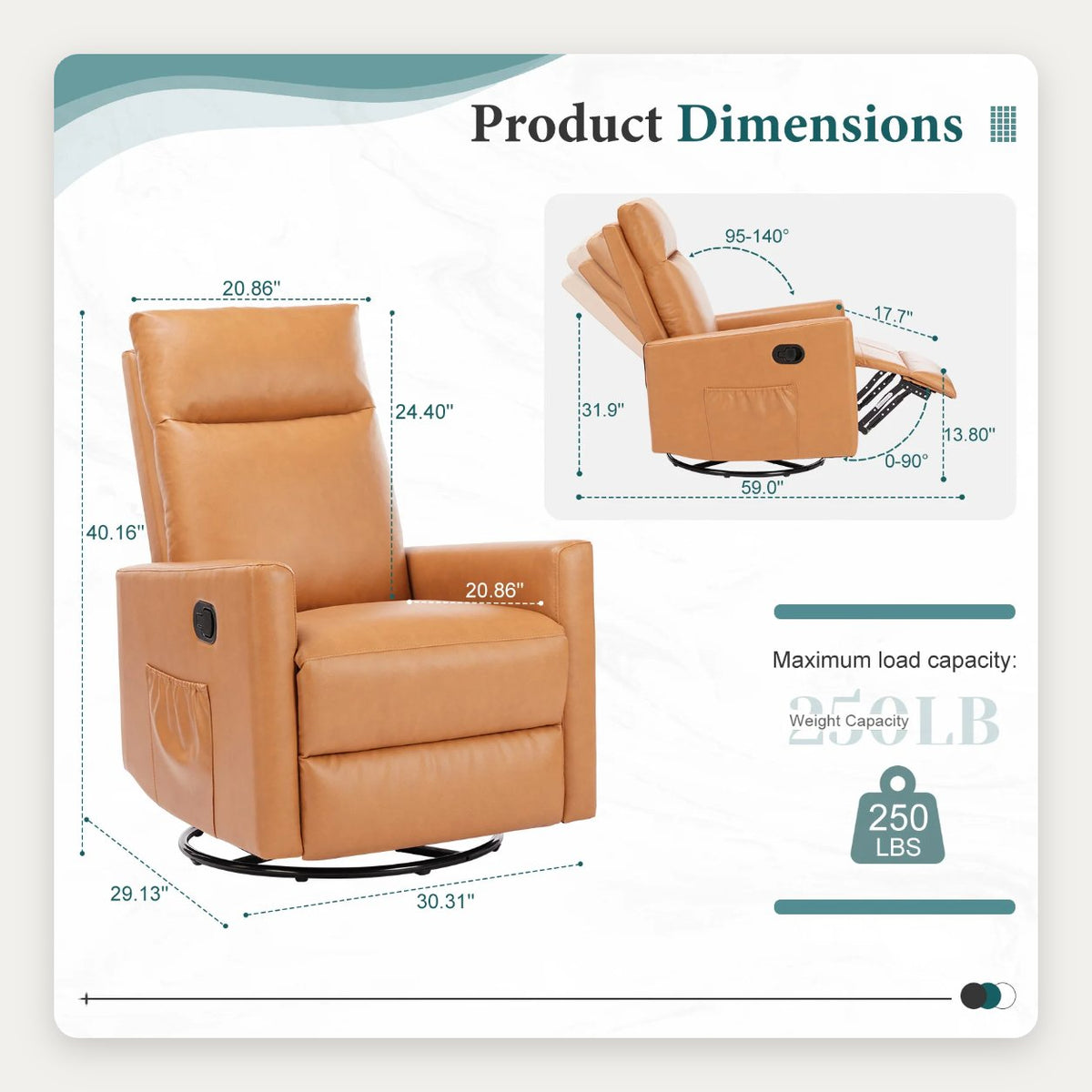
- Recliner space: standard recliners need about 12 to 24 inches behind them and stretch to roughly 60 to 70 inches long when reclined. Wall-hugger recliners need only about 4 to 6 inches.
- Row depth: plan roughly 6 to 7 feet front to back for each row of recliners, including a walkway.
- Second row: a riser of about 6 to 12 inches keeps heads out of the picture. A bar-height table and stools behind the sofa is a cheaper second row that suits game days.
In a room that mixes a bar and a screen, a 360-degree swivel rocker recliner turns between them. Theater-style recliners, sectionals and loveseats are in man cave furniture.
Sound: where the speakers go
A soundbar and subwoofer suit small rooms and garages. For a dedicated theater, use a 5.1 or 7.1 system. Dolby's published layout guidance is a good starting point:
- Front left and right: about 22 to 30 degrees either side of the center line from the main seat, at roughly ear height.
- Center channel: directly above or below the screen, angled toward the listeners' ears. It carries most of the dialogue.
- Surrounds (5.1): about 90 to 110 degrees to each side of the main seat, mounted a foot or two above ear height.
- Rear surrounds (7.1): about 135 to 150 degrees, behind the seats.
- Overhead (Dolby Atmos): ceiling speakers slightly ahead of and behind the seats, or up-firing modules that bounce sound off a flat ceiling.
- Subwoofer: start at the front of the room. For smoother bass, try the "subwoofer crawl": set the sub on your seat, play a bass-heavy track, crawl around the front of the room, and put the sub where the bass sounds most even.
Treat the room. Hard floors and bare walls make dialogue echo. A thick rug, upholstered seats, curtains, bookshelves and a few acoustic panels on the side walls at the first reflection points tame it.
Control the light
Keep fixtures out of the screen's reflection, put overhead lights on dimmers, and use soft bias lighting behind a TV. Dark walls and ceilings help a projector most. For atmosphere that doesn't fight the picture, a starlight ceiling kit over the seats is hard to beat. See man cave lighting for dimmable and accent options, and our man cave lighting ideas for layering tips.
Garage movie theater: what's different
A garage can make a great theater, but it has a few problems a basement doesn't.
- Light leaks: windows in the garage door and gaps around it wash out a projector. Cover them, watch after dark, or choose a TV.
- Temperature and humidity: check the operating temperature range in your TV and projector manuals. In an uninsulated garage, let gear warm up to room temperature before switching it on after a cold night so condensation can clear.
- The door track: ceiling-mounted projectors and TVs must clear the open door and the opener rail. A tilt and swivel ceiling mount works where wall space is taken, as long as it's outside the door's path.
- Roll-away screens: if a car still parks inside, a mobile TV cart with lockable wheels rolls the TV out for movie night and back against the wall afterward.
- Floor and echo: interlocking garage floor tiles plus a large rug under the seats warm up the concrete and cut echo.
- Power: plan outlets where the TV, receiver and subwoofer go instead of running extension cords, and use surge protection. New circuits are a job for a licensed electrician.
Building below grade instead? Our basement man cave ideas cover moisture checks and low-ceiling tricks.
Plan it before you buy
Drop the screen, seats and speakers into the Man Cave Builder at real dimensions to check distances and walkways, then browse the man cave ideas guide for bar and game zones to go with it.
Home theater man cave FAQ
What size TV should I get for my man cave?
Measure from your main seat to the screen wall in inches and divide by 1.2 to 1.6. The result is a comfortable screen size range. At 8 feet (96 inches), that's about 60 to 80 inches; at 10 feet, about 75 to 100 inches, which is projector territory at the top end.
How far should I sit from a 65 or 75 inch TV?
For a 65 inch TV, about 6.5 to 8.8 feet. For a 75 inch TV, about 7.5 to 10 feet. Those ranges match viewing angles between roughly 40 degrees, which THX recommends for immersion, and 30 degrees, the SMPTE minimum.
How high should a TV be mounted in a man cave?
Put the center of the screen at about seated eye level, roughly 40 to 42 inches from the floor for a typical sofa. If it has to go higher, use a tilting mount and angle it down toward the seats.
Can I build a home theater in my garage?
Yes. A TV handles a garage's light leaks better than a projector. Seal gaps around the door, put a rug over tiles to cut echo, keep ceiling-mounted gear clear of the door track, and check your electronics' operating temperature range if the garage isn't climate controlled.
Plan it first
Build this man cave before you buy it.
Pick your space, size, vibe and budget, and the Man Cave Builder turns it into a real kit you can add to cart in one click.
Open the Man Cave BuilderShop this guide
Man Cave


Garage Lighting
Rustic 4-Light Cage Pendant, 16 in Steel — Oak & Black


Gaming & Seating
Saddle Leather Cube Side Tables, Set of 2 Sizes — Brown


Gaming & Seating
Round Wood Coffee Table with Hidden Drawer, 33 in — Walnut


Keep reading